Digital transformation is receiving board attention, but strategic direction is lagging behind
Digitalisation is taking an increasingly prominent place in Dutch boardrooms, but the development of knowledge and strategic direction risk falling behind the pace at which new possibilities are emerging. This is one of the findings of the third survey on digital transformation, conducted by PBLQ on behalf of NR Governance and in cooperation with VNO-NCW, NLdigital and CIO Platform Nederland.
The survey of 255 board members, executives, supervisory board members and other supervisors shows that digitalisation is part of the strategy at 73 per cent of organisations. At 21 per cent, digitalisation is even at the heart of the strategy. At the same time, 63 per cent still regard IT primarily as an operational issue. AI, too, is approached strategically only to a limited extent: just 4 per cent say that AI is structurally integrated into their business or digitalisation strategy.
According to Aart Rupert, President of CIO Platform Nederland and Chief Digital Officer at Damen Shipyards Group, who provided an initial reflection on the survey findings in the report, many organisations are therefore in the transition from digital awareness to genuine digital transformation.
“Ultimately, digital transformation is not a technology issue but a governance challenge. The next step is not so much to devote more attention to digitalisation, but to strengthen digital governance, digital knowledge and the ability to jointly set the direction of change.”
The survey also shows that digital knowledge is still concentrated among a limited number of people in many organisations and that dependence on external expertise remains high. Aart Rupert therefore stresses the importance of an ongoing dialogue between executives, supervisors and CIOs about both the opportunities and risks of digitalisation. This conversation should address not only compliance and cybersecurity, but also innovation, productivity, service delivery and the creation of societal value.
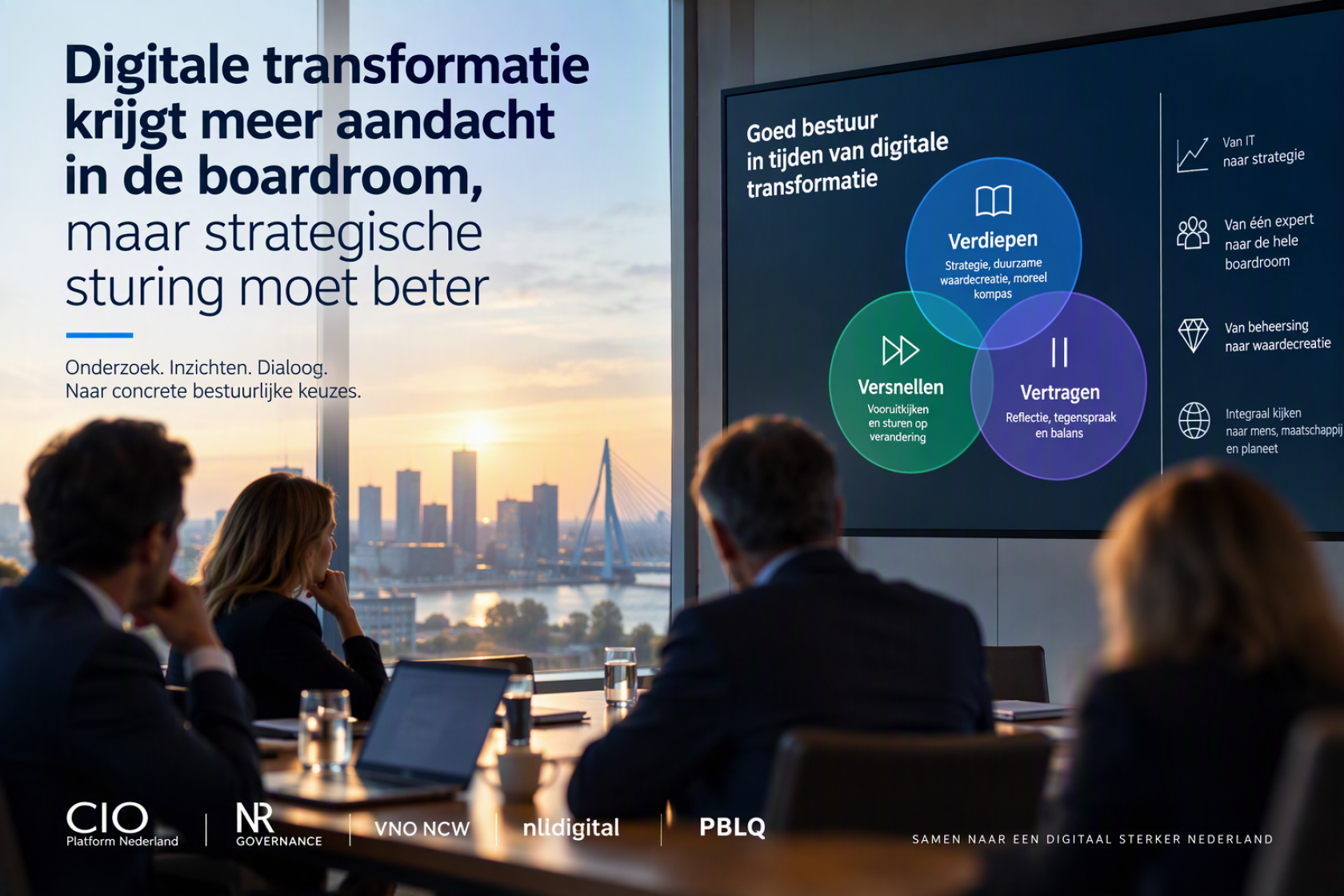
This governance challenge was also central to the meeting held on 21 October 2026, where the report was presented. Valerie Frissen, professor at Leiden University and Chair of NR Governance, summarised the challenge for good governance as deepening, accelerating and slowing down. Deepening means thinking strategically from the perspective of sustainable long-term value creation and applying critical judgement. Accelerating requires looking ahead and steering change. At the same time, slowing down is needed for reflection, constructive challenge and finding the right balance. Not everything that comes your way is worth embracing.
Coen van Oostrom, Chair of VNO-NCW, focused during the meeting on the speed at which AI is changing organisations and work processes. As a result, executives will increasingly have to make decisions quickly and on the basis of incomplete information. China and the United States in particular are managing to move at great speed, while we in Europe and the Netherlands find it especially difficult to relinquish social and other safeguards. These safeguards are important in themselves, but if they make you too slow, you will eventually no longer have to decide on such matters at all—the rest of the world will simply overtake you.
Rob van Wingerden, Chair of the Corporate Governance Code Monitoring Committee, placed the development in the context of corporate governance. The necessary shift is from IT to strategy, from control to value creation, and from a single expert to the entire boardroom. The Corporate Governance Code already provides relevant guidance, including awareness of new technology, anticipation of changing business models, and attention to cybersecurity, supply-chain dependencies, data protection and the responsible use of AI.
The survey findings and the discussion at the meeting therefore point in the same direction: digital transformation requires not only digital expertise, but also shared strategic responsibility in the boardroom.
CIO Platform Nederland aims to continue facilitating this dialogue, sharing practical experience and helping to translate digital issues into concrete governance choices. Members can pick up a printed copy of the report at one of our upcoming meetings.
Share this post!