Staying in control in the digital economy | Vision and priority agenda CIO Platform Nederland
Technology offers tremendous opportunities to innovate and work smarter. But to make the most of those opportunities, organisations must also be able to set their own course, especially in the uncertain and rapidly changing world we live in today. That is the common thread running through CIO Platform Nederland’s vision and priorities agenda: progress requires the freedom to act.

The freedom to choose, even when it matters most
Our ambition for 2031 is a digital market in which Dutch and European organisations have genuine choices. Not just when signing a contract, but years later, when their needs or circumstances change. We call this demonstrable strategic optionality. Put simply: for any process critical to your organisation, you must be able to put a viable alternative into operation within an acceptable timeframe. And where you remain dependent, that must be a conscious choice.
This does not mean every organisation should constantly switch suppliers. It does mean that staying should be a choice, not a foregone conclusion. An alternative that exists only on paper offers little reassurance when it really matters. Having the option to take a different path when you choose to creates the confidence to invest, innovate and adopt AI responsibly.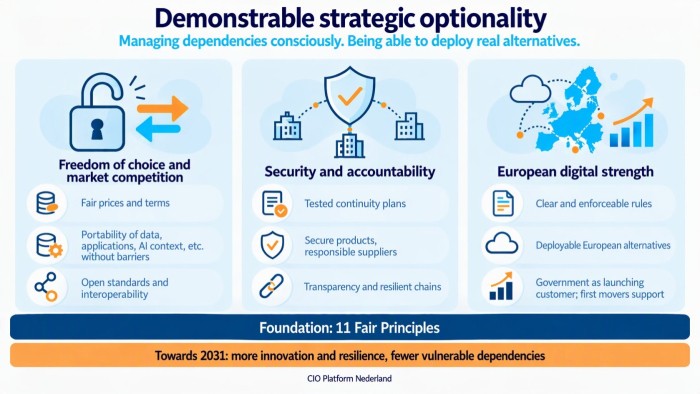
A healthy market creates room to manoeuvre
This is where our commitment to freedom of choice and effective competition begins. Organisations that want to switch should not be held back by opaque licensing, high exit costs or systems that barely work with other solutions. And you are only truly free to leave if you can take not just your files, but also your applications, process logic and relevant AI context with you.
That is why we advocate fair terms, open standards and control over one’s own data. Organisations need to know what happens to their data, including its use in AI training, and be protected against unwanted use or transfers to third countries. This requires suppliers that provide that freedom, as well as regulators that take action when dominant players restrict it.
The Data Act’s switching rules must therefore deliver in practice. But rules alone are not enough. There must also be attractive alternatives. Strong European providers and open software ecosystems make the market more diverse and give users more choice.
Responsibility cannot simply be passed on
Freedom of choice and security are closely connected. After all, what use is an alternative if you cannot fall back on it when an incident occurs? Organisations need to know how they will keep operating if a critical service fails, how they will recover and which processes need to restart first. This calls for plans that do not sit in a drawer, but are actually tested. That responsibility lies with boards and CIOs themselves.
At the same time, users cannot bear all the responsibility. We should be able to expect suppliers of digital technology to build in security and quality from the outset, and to continue providing support after the agreement has been signed. Especially at a time when the number and complexity of cyberattacks are increasing dramatically through the use of AI, suppliers must take responsibility for using AI to protect their customers swiftly and effectively. Suppliers also have a responsibility to ensure that their customers can act in compliance with the legislation that applies to them.
Europe must have something to offer, too
If we want to be less dependent on existing suppliers, we also need to build alternatives. That is why strengthening Europe’s digital capabilities is a central part of our agenda. Europe needs room for providers to grow and for organisations to use their solutions. Clear, proportionate and workable rules are essential, as is their consistent application across the European market.
Alongside workable rules, we need a market in which new solutions can prove themselves. We must therefore help providers of alternative solutions move beyond the start-up phase, so they can serve demanding, mature customers. And European offerings must become available for the most critical services, such as digital identity and access management, cloud infrastructure and AI-driven cybersecurity.
For such offerings to emerge and grow, providers need the prospect of long-term customers. Governments can help kick-start this development by acting as launching customer. And by compensating the first customers of new European services for their switching costs, we can lower the barrier to giving these alternatives a real chance.
The aim is not to choose European technology exclusively. The aim is to have more choice. This strengthens our negotiating position and makes us less vulnerable to geopolitical pressure and decisions over which we have little influence.
From shared experience to collective influence
Freedom of choice, security and European digital capabilities are not separate ambitions. Together, they determine how much control we have over our digital future. At CIO Platform Nederland, we bring together the experiences of major business and public-sector users. We take the issues our members encounter in practice into our discussions with suppliers, policymakers and legislators. The 11 Fair Principles, which we developed with our sister associations in Belgium, Germany and France, provide a shared foundation for that dialogue.
None of these parties can shape that future alone. It takes boards and CIOs willing to confront their dependencies, suppliers that take responsibility, and governments that enable fair competition and innovation. That is the contribution we want to make as an association: grounded in practice and guided by the freedom to act.
Digital progress is not just about what technology can do. It is also about having the freedom to decide what we want to do with it. That is how we stay in control.
More information? Please send an email to the CIO Platform Nederland office.
Share this post!